All work Brainex Full-stack
Brainex — Modular Enterprise Platform
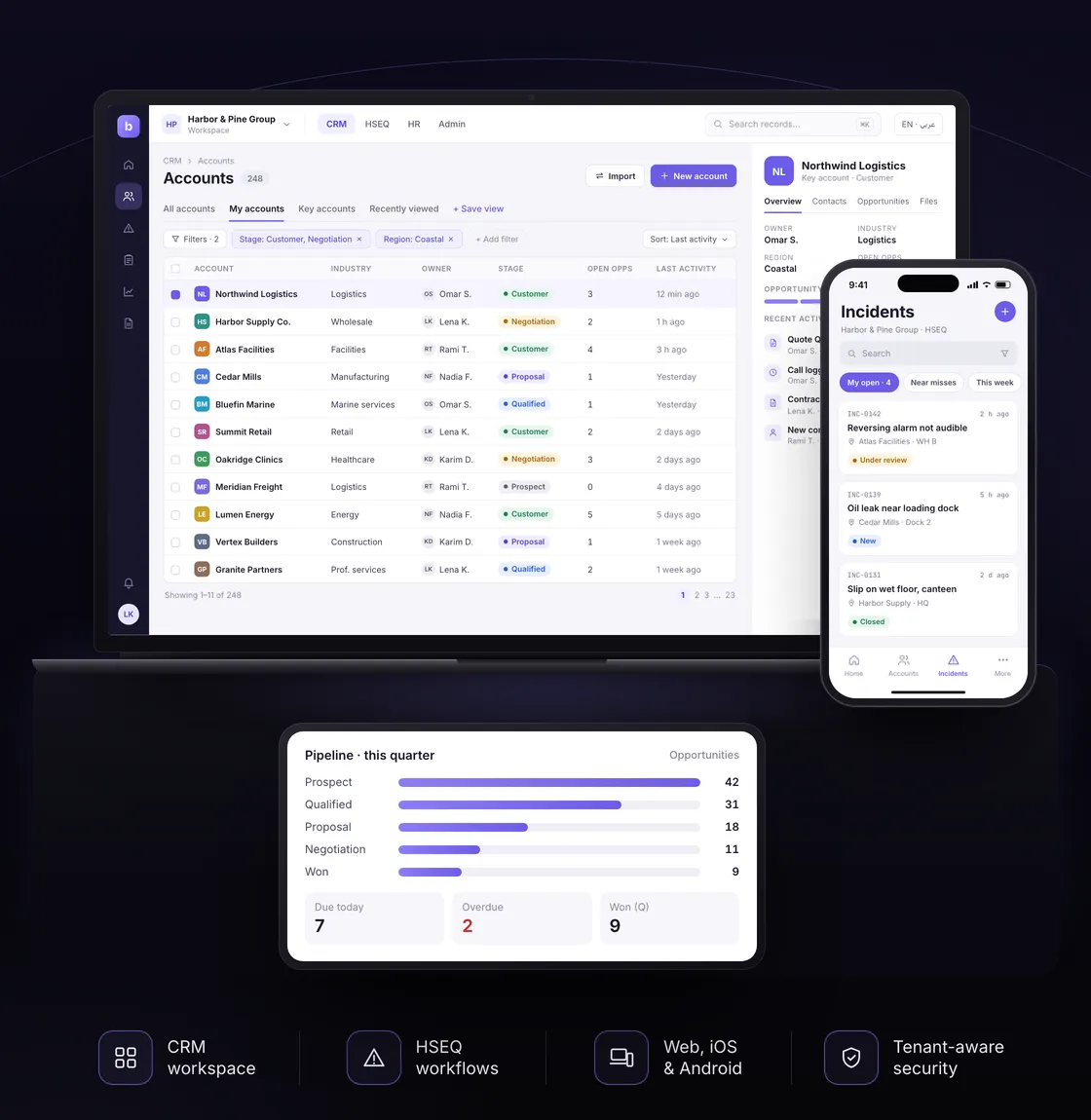
A modular enterprise platform — CRM, HSEQ, HR, a customer portal and administration — on one shared foundation for web, iOS and Android.
01 Context
BrainexOne is enterprise software: several business domains — sales and customer relationships, health, safety, environment and quality (HSEQ), people, and administration — run as modules on one shared platform, delivered on the web and as native iOS and Android apps. I work on it as a full-stack software engineer at Brainex, alongside the wider engineering team.
02 Challenge & constraints
Growing businesses often manage sales, operations, safety, employees, documents, and customer communication through disconnected systems. One platform has to serve all of them with shared data, consistent workflows and role-based access — while keeping every tenant's data isolated and every change auditable, on web, iOS and Android.
Constraints
- Many modules on one foundation — a new workflow shouldn't mean a new set of one-off screens.
- Tenants share the platform, so data isolation has to hold in every module.
- Records move through lifecycles, and changes need an audit trail.
- Web, iOS and Android all work against the same APIs and data.
- English and Arabic, with full right-to-left layouts.
03 Architecture
Every client works against one shared C#/.NET API layer on PostgreSQL. Modules are built on a shared, metamodel-driven foundation, and tenant isolation, permissions and audit history apply across all of them.
- ClientsEnglish and Arabic, with right-to-left layouts
- Web app — Next.js / React
- Mobile apps — React Native + Expo (iOS, Android)
- Modules
- CRM
- HSEQ
- HR
- Customer portal
- Administration
- API layer
- C# / .NET APIs
- Shared by web and mobile
- Platform foundation
- Metamodel-driven forms & list views
- Workflow & lifecycle controls
- Documents & notifications
- Dashboards
- Data
- PostgreSQL
- Migrations
- Tenant isolation
- Permissions & role-based access
- Audit history
- Localization (EN / AR)
04 What I built
Split by ownership, so what I built myself and what I contributed to as part of a team stay distinct.
Built / implemented
- CRM features — leads, accounts, contacts, opportunities, quotes, contracts, products, orders and invoicing, with documents, notifications, list views, filters and dashboards.
- HSEQ workflows — concern reporting, improvement actions, incidents and near misses, and inspections, with tenant isolation, permissions, audit history, migrations and lifecycle controls.
- Bilingual React Native / Expo apps for iOS and Android — secure authentication, English/Arabic with RTL, reusable MVVM architecture, saved views, dynamic filtering and maps.
Contributed to
- Platform security — implemented permission-system capabilities, role-based authorization and authentication fixes; access-management testing.
- Validation and release — UAT, Azure environments, GitHub Actions CI/CD pipelines, deployments, monitoring and logging.
- Customer-portal prototypes, App Store / Google Play preparation and technical documentation.
Collaborated on
- AI-assisted delivery — evaluating language models, governance for AI coding assistants, automated code-review workflows, token and performance optimization.
- Requirements, implementation approach and technical structure across modules.
05 Engineering decisions
-
Metamodel-driven, reusable UI
Forms, list views, filters and dashboards come from a shared foundation, so a new CRM or HSEQ workflow doesn't start from a blank set of screens.
See the architecture -
Permissions across modules
Permission checks and role-based authorization are implemented across platform modules, and access management has its own testing.
Engineering note · 4 min Role-aware UI is not authorization -
Tenant boundaries
Tenant isolation is built into the HSEQ workflows, alongside audit history and migrations.
-
Lifecycle-driven workflows
HSEQ records — concerns, incidents, inspections, improvement actions — move through explicit lifecycles, and every change is recorded.
-
One backend for three platforms
The Next.js web app and the iOS and Android apps call the same C#/.NET APIs and PostgreSQL data.
-
Bilingual mobile from day one
English and Arabic with full RTL, secure authentication, a reusable MVVM architecture, saved views, filtering and maps.
Engineering note · 3 min One interface for English and Arabic -
Validated before release
Access-management testing and UAT come before Azure deployments through GitHub Actions, with monitoring and logging afterwards.
Interface
Interface concepts drawn for this portfolio with fictional data — not production screenshots.
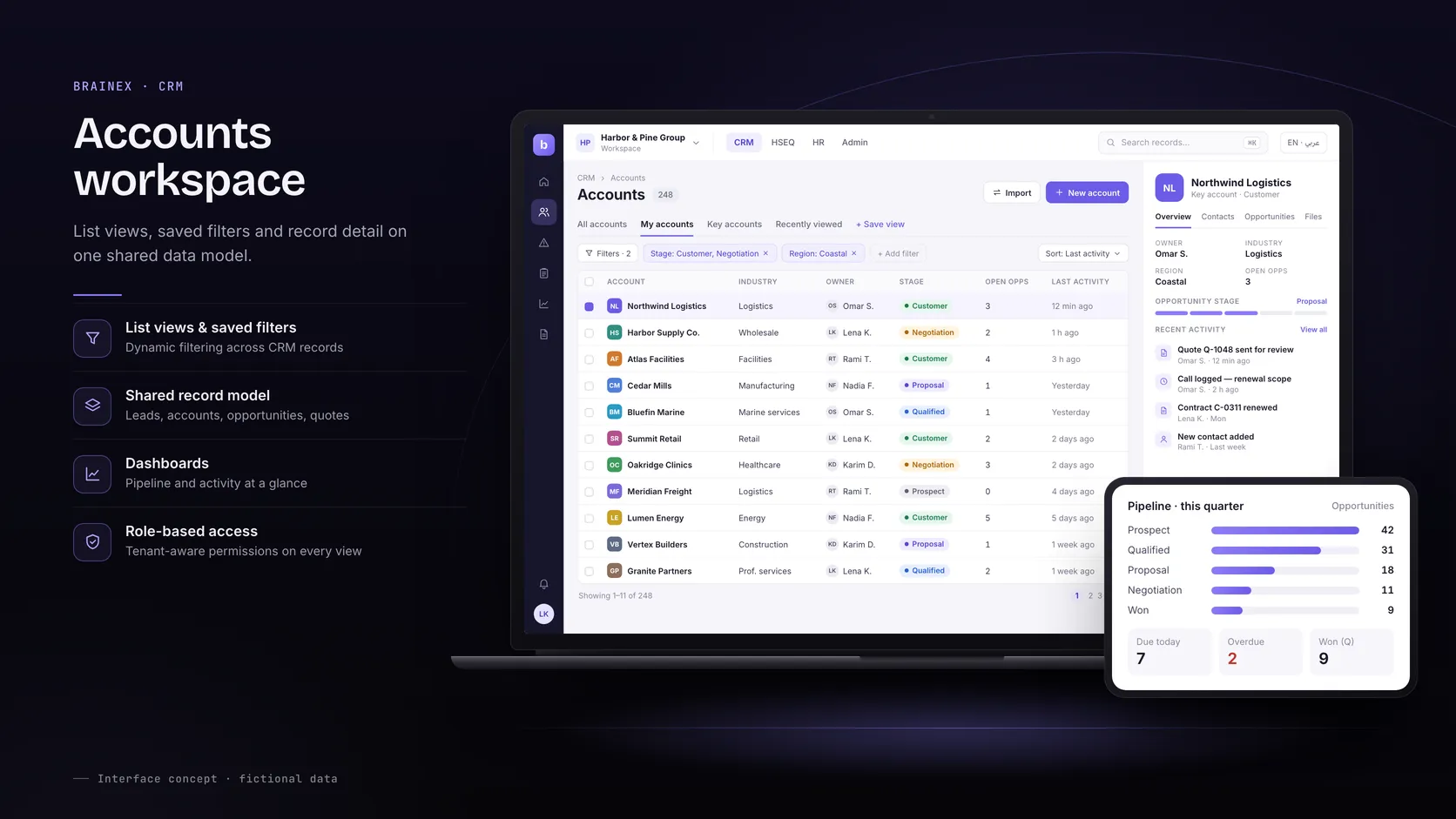
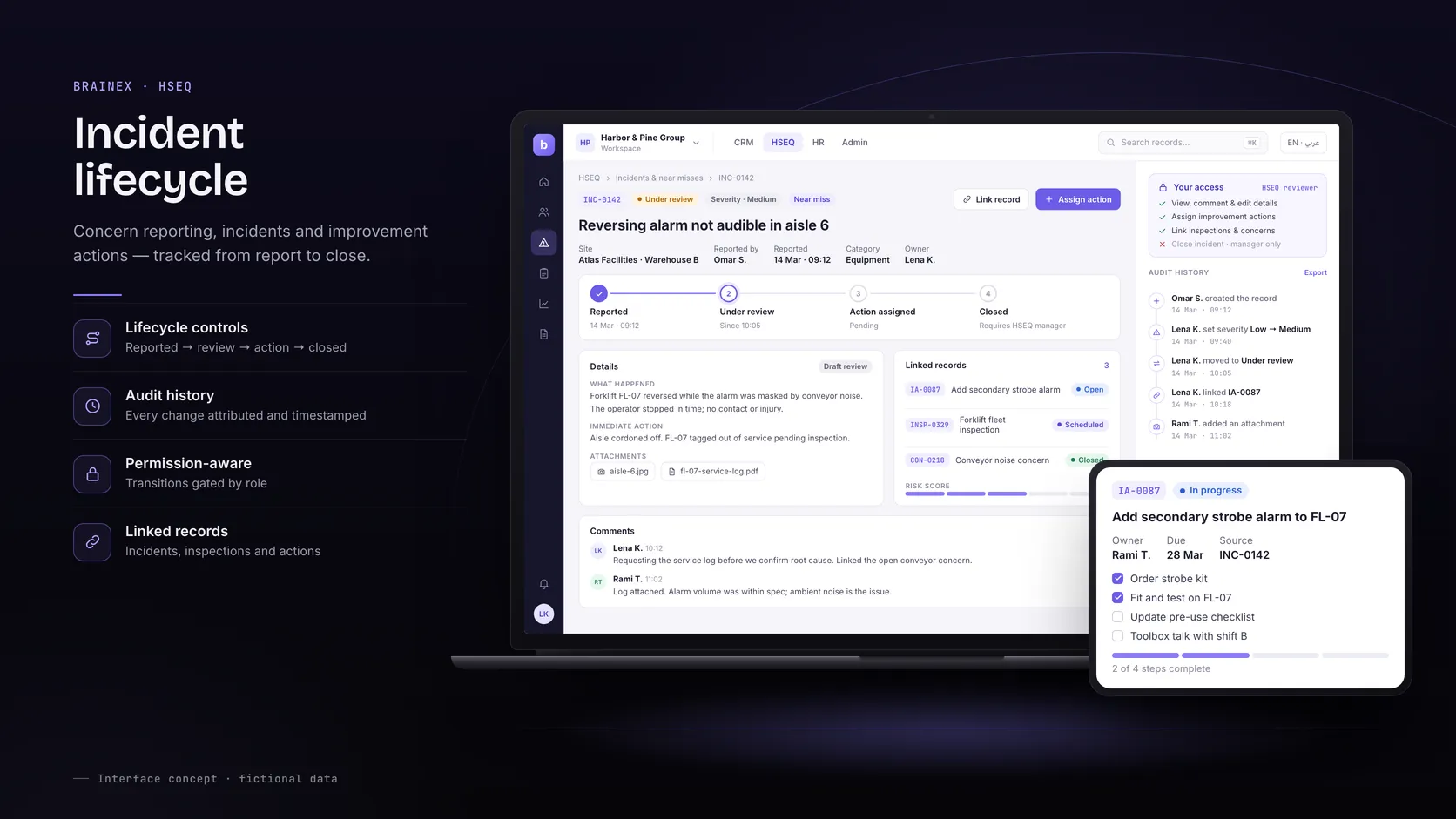
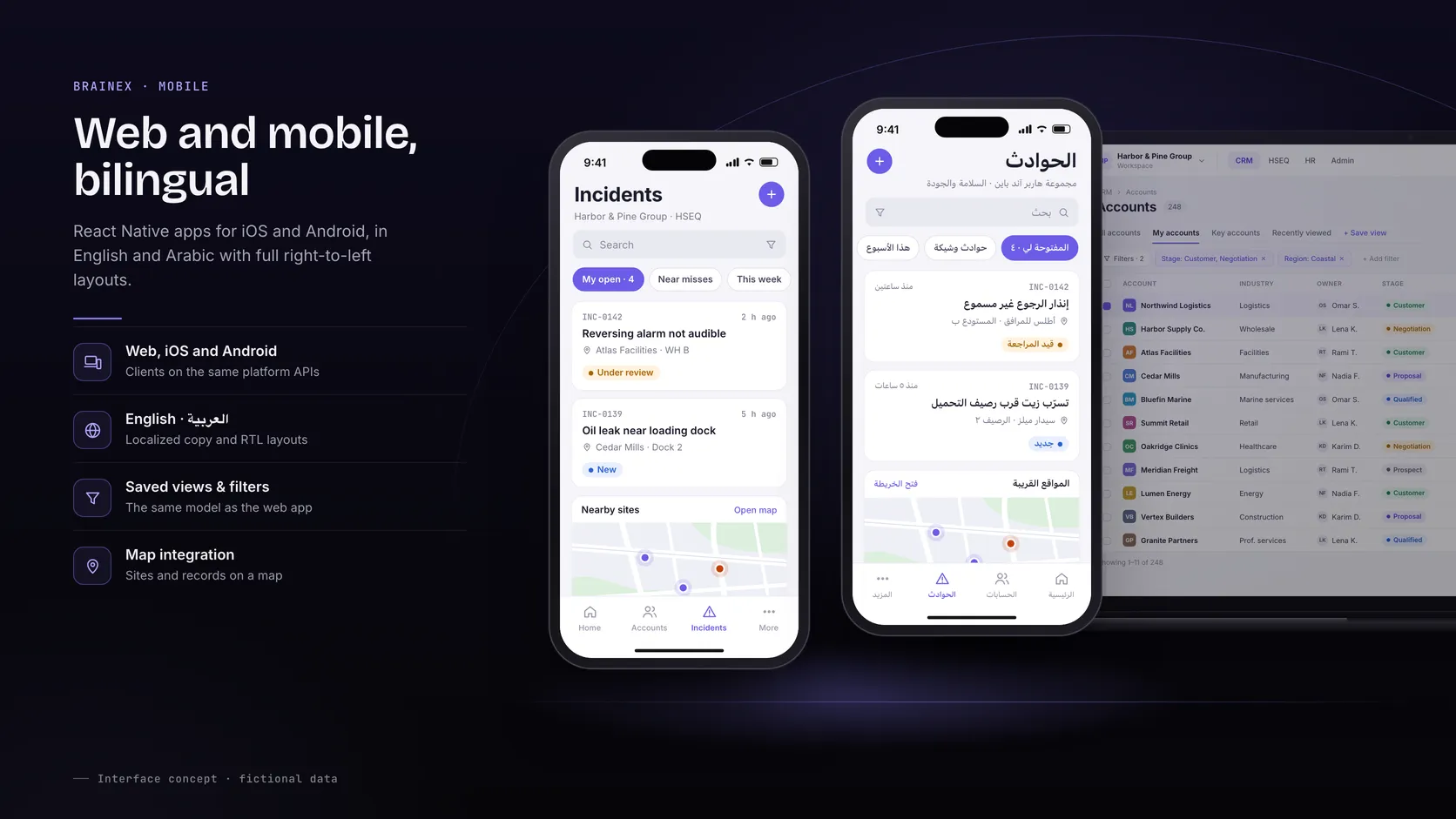
CRM list views with saved views and dynamic filters, record detail and a pipeline dashboard on one shared data model.
- List views
- Filters
- Dashboards
06 Results & scope
- 4 HSEQ workflow areas built — concerns, improvement actions, incidents & near misses, inspections
- 9 CRM record types implemented — leads to invoices
- 3 Platforms on one API layer — web, iOS and Android
- 2 Languages — English and Arabic, with full RTL